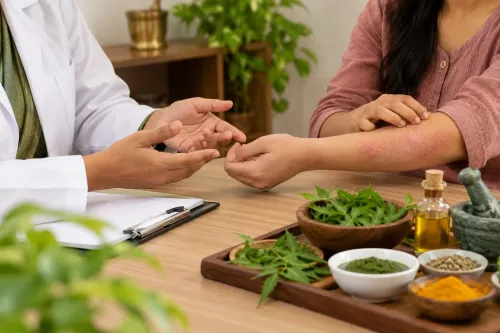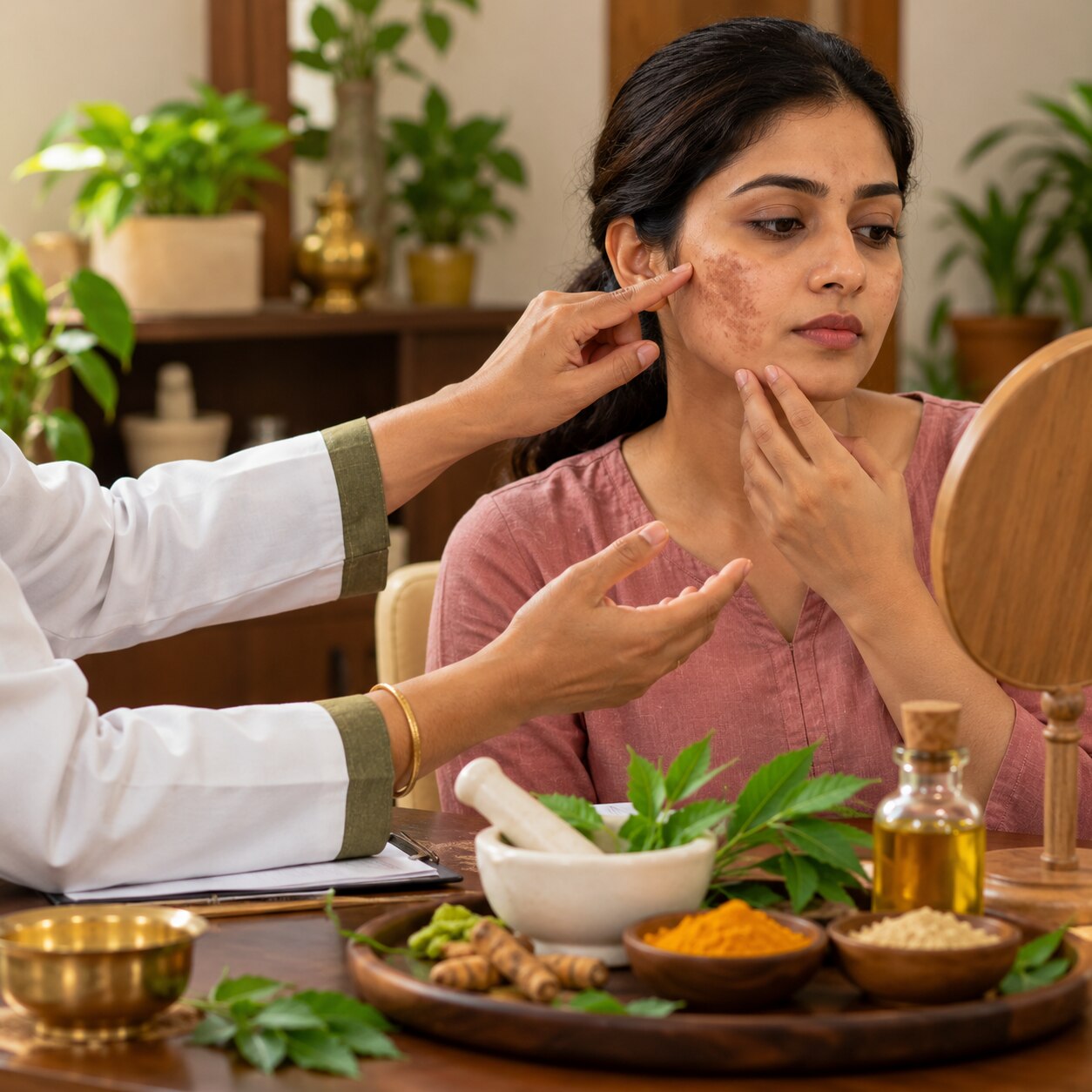
Dark patches do not all have the same cause, so a paste or oil that suits post-acne marks may be inappropriate for melasma, eczema, infection, or a changing mole. You will learn how to identify the pattern, evaluate Ayurvedic options safely, protect your skin from further pigment production, and recognise when medical assessment comes first.
Key takeaways
- Match the remedy to the pigment’s pattern, timing, colour, and trigger.
- Seek examination for rapidly changing, bleeding, painful, or one-sided dark patches.
- Ask how deeply the pigment lies before choosing topical or internal treatment.
- Stop anything that causes burning, blistering, swelling, or persistent redness.
Identify the Type of Pigmentation Before Choosing a Remedy
Uneven skin tone is a description, not a diagnosis. Look at the pattern, timing, colour, and trigger before choosing a remedy; hyperpigmentation from one cause can worsen with treatment meant for another.
| Condition | Typical clues | What it suggests |
|---|---|---|
| Melasma | Symmetrical brown or gray-brown patches on the cheeks, forehead, upper lip, or jaw; linked with pregnancy, hormones, or sunlight | Needs strict sun protection and clinical assessment |
| Post-inflammatory hyperpigmentation after acne or injury | Flat brown marks left after pimples, eczema, burns, cuts, or irritation; the original inflammation has settled | Can fade over months, but scrubbing or irritating products can keep it active |
| Sun spots | Individual, sharply defined tan-to-brown spots on areas repeatedly exposed to sunlight, usually after years of exposure | Have changing spots examined before cosmetic treatment |
| Freckles | Small, flat light-brown spots that become more visible in summer and often run in families | Usually benign; they are not the same as melasma |
| Other causes | Thick, velvety darkening on the neck or armpits; fine scaling; sharply white patches; or widespread colour change | Consider acanthosis nigricans, tinea versicolor, vitiligo, medicine-related pigment, or another condition needing diagnosis |
Arrange an examination if a mark changes quickly, develops irregular borders, bleeds, crusts, hurts, or appears suddenly after a new medicine or illness. A clinician will review sun exposure, acne or eczema, pregnancy or hormonal changes, and medicines, then inspect the skin; a Wood lamp or laboratory tests may help when the cause is unclear.
Know Which Pigmentation Needs a Medical Examination
Do not start a cosmetic lightening treatment if the colour change is new, symptomatic, or changing. “Uneven skin tone” is not a diagnosis; dermatitis, infection, drug reactions, vitiligo, and other disorders can resemble ordinary pigmentation.
| Warning sign | Why it needs assessment | What to do |
|---|---|---|
| rapidly changing dark spot | A changing mole or other lesion needs examination | Arrange a dermatologist visit promptly |
| irregular borders | Uneven edges can signal a lesion that requires diagnosis | Do not apply lightening cream before assessment |
| bleeding or crusting | Damage on the surface is not typical of stable pigmentation | Seek medical care rather than covering it cosmetically |
| painful pigmentation | Pain, burning, or tenderness can indicate inflammation or infection | Stop new products and arrange an examination |
| sudden widespread darkening | A medicine, illness, or hormonal change may be involved | Take your medication and illness history to a clinician |
| pigment on the lips or inside the mouth | Mucosal pigmentation has causes that skin creams cannot clarify | Request a medical evaluation |
Also seek care for persistent itching, scaling, or pigment that spreads quickly. An unlabelled “fairness” cream can contain mercury or a topical corticosteroid; temporary lightening can hide inflammation while causing kidney or neurological toxicity, skin thinning, acne-like eruptions, or rebound darkening. Bring the product packaging and a dated photograph to the appointment.
How a Clinician Evaluates the Cause and Depth of Pigment
A clinician combines pigmentation assessment with your history and a close skin examination before recommending treatment. “Uneven tone” is a description, not a diagnosis, so the cause and pigment depth must be identified first.
The clinician will ask about:
- Medical history, including acne, eczema, injury, infections, thyroid or hormonal symptoms, and the timing of the colour change
- Sun exposure, tanning habits, and whether the patches worsen during summer
- Pregnancy, breastfeeding, menstrual or hormonal changes
- Medication review, including antibiotics, anticonvulsants, hormones, and products applied to the skin
- Previous lightening creams, peels, supplements, or Ayurvedic formulations
A skin examination assesses colour, surface texture, symmetry, borders, and whether pigment sits mainly in the epidermis or deeper dermis. Brown pigment is more often epidermal and may respond better to topical care; blue-gray pigment suggests dermal involvement and is harder to treat.
A Wood lamp examination can support this distinction, but it is less reliable in darker skin and never replaces diagnosis.
Velvety thickening on the neck, armpits, or groin prompts assessment for acanthosis nigricans and possible insulin resistance. A clinician may request fasting glucose or HbA1c, or other tests guided by your symptoms and medicines. Dermoscopy or biopsy is appropriate for an unusual, changing, bleeding, crusted, or painful spot.
Ayurvedic care fits best after a clear diagnosis and safety review. Uncertain, deep, widespread, suddenly appearing, pregnancy-related, or medicine-related pigmentation needs dermatological assessment before cosmetic treatment.
What Ayurvedic Remedies Can and Cannot Do
Ayurvedic remedies can improve dryness, irritation, and overall skin appearance, but they cannot reliably erase established pigment. Brown epidermal pigment tends to respond better than blue-gray dermal or mixed pigment, which is more resistant and needs a realistic treatment plan.
| Form | Possible role | Main limitation |
|---|---|---|
| Ayurvedic topical paste | Delivers plant ingredients directly to the skin; licorice-derived glabridin or liquiritin may reduce pigment-forming activity | Evidence from small studies does not prove that every paste treats melasma; irritation can worsen pigmentation |
| Ayurvedic oil | Softens dry, irritated skin and supports the skin barrier | An oil is not a proven pigment remover, and fragranced oils can trigger dermatitis |
| Herbal cleanser | Removes sweat, oil, and residue without harsh scrubbing | Rinse-off contact is brief, so lightening effects are limited |
| Oral Ayurvedic preparation | May be prescribed for an underlying health pattern after clinical assessment | Do not self-dose; contamination, drug interactions, and pregnancy risks are possible |
Trial one product at a time. Patch-test it on a small area for 48 hours, then apply a thin layer to a limited pigmented area rather than the whole face. Stop if you develop burning, swelling, blisters, or darker marks, and reassess after 8 to 12 weeks with consistent sun protection.
Avoid self-treatment with bakuchi or babchi, especially concentrated or oral products; psoralen-related compounds can cause painful ultraviolet reactions and later darkening. Pregnancy and breastfeeding require clinician review. A label reading “natural” or “Ayurvedic” does not rule out mercury, hydroquinone, corticosteroids, or heavy-metal contamination.
Make Any Pigmentation Plan Safer and More Effective
A safer plan starts by protecting the skin barrier, because irritation from scrubbing, acids, or a strong “brightening” blend can create more post-inflammatory pigmentation.
Patch testing means applying the product to a small area, such as behind the ear or on the forearm, and watching for redness, itching, swelling, burning, or blisters for 48 hours before facial use.
- Use one new topical product at a time, and stop it if burning or a rash develops.
- Avoid oral or concentrated bakuchi (babchi) unless a qualified clinician has specifically assessed it; bakuchi phototoxicity can cause painful redness, blisters, and darker marks after ultraviolet exposure.
- During pregnancy or breastfeeding, show the complete ingredient list to your obstetrician or dermatologist before using a pigment remedy. Do not assume that “natural” means pregnancy-safe.
- Apply SPF 30 broad-spectrum sunscreen every morning, then reapply after sweating, swimming, or prolonged outdoor exposure. A tinted sunscreen containing iron oxides adds visible light protection; hats and shade help but do not replace sunscreen.
Reject products with no manufacturer, batch number, ingredient list, or sealed packaging. “Ayurvedic,” “herbal,” and “natural” labels do not rule out mercury, hydroquinone, potent corticosteroids, or heavy-metal contamination. Rapid lightening from an unlabelled fairness cream can signal steroid damage, skin thinning, acne-like eruptions, or rebound darkening.
If you consult AyurBless Clinic, ask for the proposed ingredients, pregnancy precautions, duration, review date, and stop rules in writing; choose professional care only when the plan allows diagnosis and monitoring rather than promising instant lightening.
Frequently asked questions
Why identify the type of pigmentation before choosing an Ayurvedic remedy?
Uneven skin tone can result from different causes. Compare the pattern, timing, colour, and trigger because a remedy suited to one cause can worsen another.
Which pigmentation needs a medical examination?
Arrange an examination for a rapidly changing patch, irregular borders, multiple colours, bleeding, crusting, pain, itching, or a new one-sided dark mark.
How does a clinician evaluate the cause and depth of pigment?
A clinician reviews your history, medicines, sun exposure, inflammation, and timing, then examines the pattern and may use magnification or a dermatoscope to assess the skin.
What can Ayurvedic remedies do for pigmentation?
They can support a personalised plan for skin care and underlying health factors, but they cannot guarantee pigment removal. Protecting skin from ultraviolet exposure and avoiding irritation remain essential.