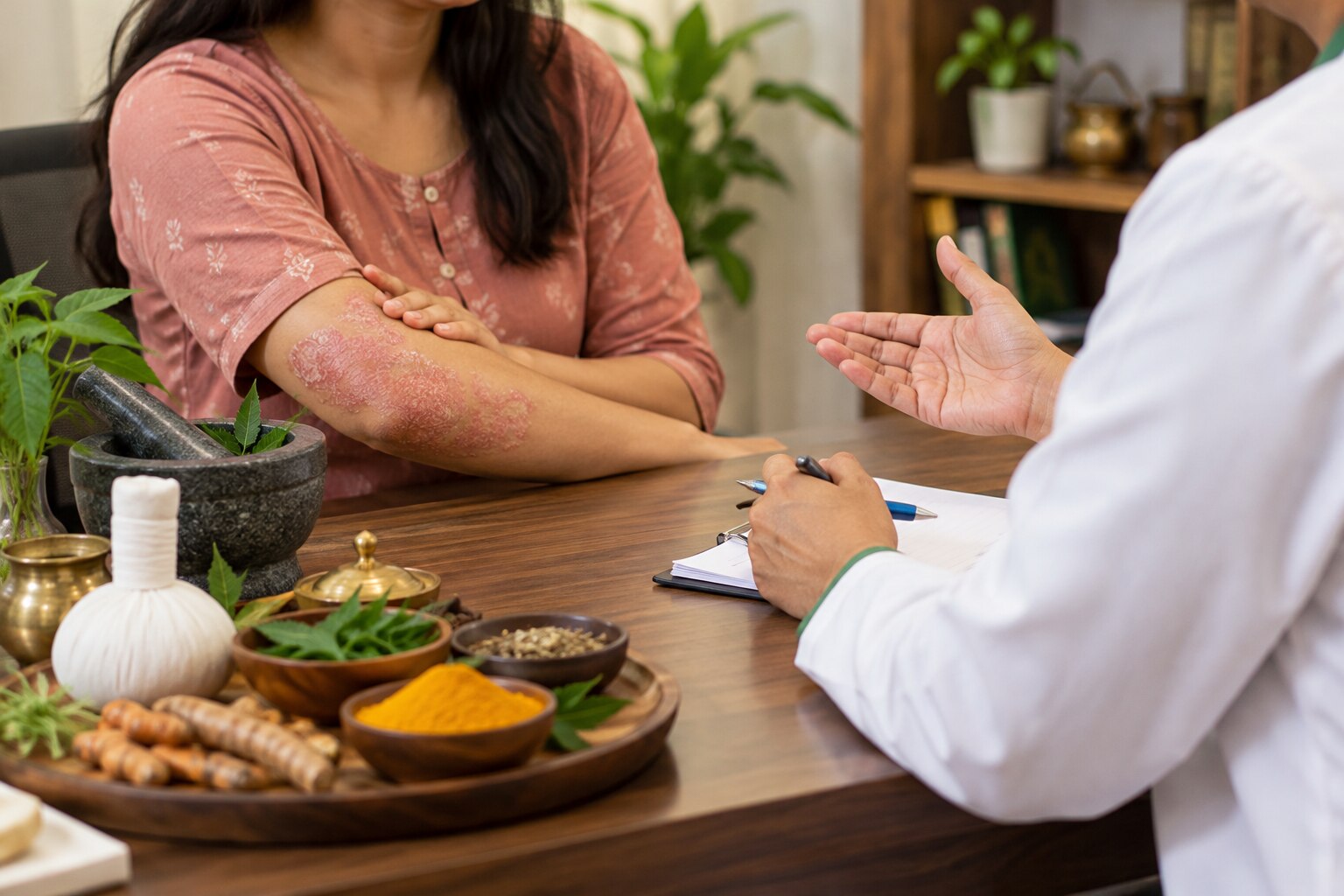
Psoriasis is a chronic immune-mediated disease, not a hygiene problem, and its plaques can resemble eczema, fungal infection, or other skin conditions. By the end, you will be able to recognise common psoriasis patterns, understand how Ayurveda uses terms such as Kitibha Kushta, assess complementary-care claims, and identify when dermatologic or joint evaluation is urgent.
Key takeaways
- Psoriasis plaques are raised, inflamed areas covered by dry white or silvery scale.
- Joint pain, swelling, or morning stiffness can signal psoriatic arthritis.
- Ayurveda can inform supportive care but does not replace a dermatologic diagnosis.
- Seek prompt care for rapidly spreading rash, infection signs, or severe joint symptoms.
What Psoriasis Looks Like and Why the Skin Scales
Psoriasis is a chronic immune-mediated skin disease in which inflammation speeds up skin-cell production. New cells reach the surface in days instead of weeks, so they accumulate into raised plaques; compact dead cells create dry white or silvery scale. Inflammation causes redness and itching, while cracking or scratching can cause bleeding.
Psoriasis is not caused by poor hygiene and is not contagious.
| Pattern | What it looks like and where it appears |
|---|---|
| Plaque psoriasis | Sharply demarcated, raised red plaques covered by silvery scale, often on the scalp, elbows, knees, and lower back |
| Guttate psoriasis | Numerous small, drop-shaped scaly spots scattered across the trunk and limbs |
| Inverse psoriasis | Smooth, shiny, bright-red patches in skin folds, including the groin, armpits, and under the breasts; scale is limited because moisture softens it |
| Pustular psoriasis | Tender red skin covered with pus-filled bumps, which can occur in localised areas or across much of the body |
| Erythrodermic psoriasis | Widespread intense redness with peeling or shedding that covers most of the body and requires urgent medical care |
The scalp can develop thick scale that extends beyond the hairline, and nails can show pinpoint pits, ridges, discoloration, or lifting. Genital psoriasis often looks smooth and red rather than heavily scaled. In Ayurveda, practitioners may compare some plaque-like presentations with Kitibha Kushta, but that traditional analogy is not a one-to-one biomedical diagnosis.
Recognising Psoriasis, Similar Rashes, and Joint Involvement
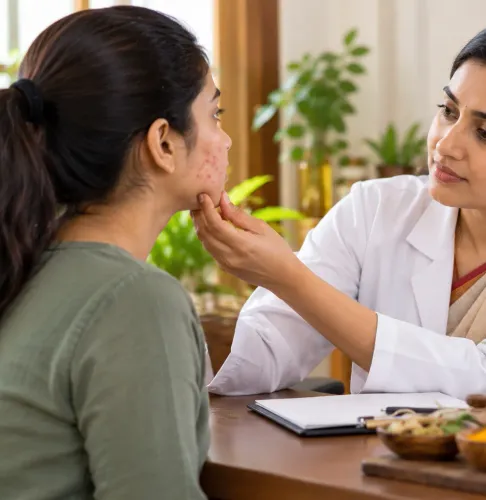
A diagnosis should be confirmed before you begin prolonged treatment. Clinicians inspect the distribution, border, scale, nails, scalp, folds, and genitals, then ask about new medicines, infections, exposures, and family history. If the appearance is uncertain, a skin scraping, bacterial or fungal test, biopsy, or medication review can prevent the wrong treatment.
An eczema vs psoriasis comparison often starts with these clues:
| Condition | Clues that distinguish it |
|---|---|
| Psoriasis | Well-defined plaques with thicker, silvery scale; nail pitting supports the diagnosis |
| Eczema | More poorly defined, intensely itchy, dry or oozing patches, often in skin creases |
| Seborrheic dermatitis | Greasy scale on the scalp, eyebrows, ears, or sides of the nose |
| Fungal infection | Ring-shaped border or one-sided rash; skin scraping can identify fungus |
| Contact dermatitis | Rash matches an exposure, such as fragrance, hair dye, adhesive, or metal |
Inverse psoriasis affects folds with smooth, bright-red patches and little scale. Pustular psoriasis produces pus-filled sterile spots, while erythrodermic psoriasis causes widespread redness and peeling.
Skin disease requires assessment beyond the skin when joints hurt, swell, stiffen for more than 30 minutes after waking, or lose movement. These symptoms can indicate psoriatic arthritis; screening also matters because psoriasis is associated with cardiovascular disease, metabolic syndrome, depression, and inflammatory bowel disease.
Seek prompt care for rapidly spreading redness, fever, severe pain, or widespread pustules. Do not stop prescribed treatment abruptly to try an Ayurvedic regimen; rebound can follow some medicines. Track body-surface involvement, plaque severity, itch, and joint symptoms with your clinician.
How Ayurveda Interprets Psoriasis Without Replacing a Diagnosis
Kitibha Kushta is an Ayurvedic comparison for certain chronic, dry, thickened, scaly skin patterns that can resemble plaque psoriasis. It belongs to the broader category of Kushta, meaning a group of skin disorders in Ayurvedic texts.
It is not a one-to-one translation of modern psoriasis, and it cannot identify a psoriasis subtype or confirm the diagnosis.
Prakriti describes your baseline constitution in Ayurvedic theory, while Vikriti describes the person’s current state of imbalance or illness. A practitioner may use both concepts to build an individualized treatment plan rather than treat every person with psoriasis identically.
A traditional dosha assessment may consider:
- The pattern, thickness, dryness, colour, and location of lesions
- Itching, pain, cracking, sleep, digestion, and perceived flare triggers
- Diet, daily routine, stress, climate, medicines, and personal history
This assessment does not measure immune activity, rule out fungal infection, or detect psoriatic arthritis. Two practitioners can therefore assign different dosha patterns and recommend different diets, oils, herbs, or procedures for the same person. Those recommendations are not proof that psoriasis results from “toxins,” poor digestion, or personal behaviour.
Keep the biomedical diagnosis separate. A dermatologist identifies psoriasis from its appearance, history, and examination, and investigates alternatives when needed. Use Ayurvedic interpretation as complementary context, not as a reason to stop prescribed treatment or delay assessment of new, spreading, painful, or joint-related symptoms.
Using Ayurvedic Care Safely Alongside Dermatologic Treatment
Keep prescribed dermatologic treatment in place while you assess Ayurvedic treatment for psoriasis. Evidence for individualized regimens, herbs, Ayurvedic oils, and procedures is much thinner than evidence for topical corticosteroids, vitamin D analogues, phototherapy, systemic medicines, and biologics. A reported improvement does not show which ingredient worked or whether it will work across psoriasis types.
Check every product’s full ingredient list, manufacturer, batch number, expiry date, and testing information. “Natural” does not mean harmless: herbs can interact with medicines, and some Ayurvedic products have contained toxic amounts of lead, mercury, or arsenic.
Stop a product that causes burning, swelling, worsening rash, or new symptoms, and show the container to your dermatologist.
Use oils cautiously. Test a small area first, avoid applying scented or multi-herb oils to cracked or infected skin, and do not assume oil can replace anti-inflammatory treatment.
Change your diet only for a clear reason, such as a diagnosed allergy or deficiency; broad exclusions can cause nutritional problems and make it harder to identify the real trigger.
Before starting, ask:
- What exact ingredient, dose, duration, and monitoring plan apply?
- Could this interact with my prescriptions, pregnancy, kidney disease, or liver disease?
- What evidence supports this product or diet for psoriasis rather than general wellbeing?
- What happens if I decline panchakarma?
Treat panchakarma and other cleansing practices as optional, unproven interventions, not removal of a psoriasis cause. Fasting, vomiting, purging, or unsupervised laxatives can cause dehydration, electrolyte disturbances, and medication problems.
At AyurBless Clinic, bring your dermatologist’s diagnosis and complete medication list so Ayurvedic advice can be evaluated for natural treatment safety rather than used in isolation.
Choosing Treatment and Knowing When to Seek Prompt Care
The best psoriasis treatment options depend on extent, location, joint symptoms, other illnesses, previous treatment, and your preferences. Confirm the diagnosis before prolonged treatment, then review response with a clinician rather than replacing effective medicine abruptly.
| Option | What it involves | Key safeguard |
|---|---|---|
| Topical treatment | Corticosteroids, vitamin D analogues, or other prescribed creams and ointments | Follow duration and site instructions; sudden withdrawal of potent products can trigger rebound |
| Phototherapy | Medically supervised narrowband UVB with planned dose increases | Do not substitute tanning beds, deliberate sunburn, or sunlight combined with photosensitising herbs |
| Systemic medicines and biologics | Oral or injectable treatment for extensive, disabling, or resistant disease | Discuss infections, pregnancy, liver health, and monitoring blood tests before starting |
| Ayurvedic or supportive care | Stress management, moisturising, and personalised lifestyle guidance | Use alongside, not instead of, dermatologic care; disclose every herb and product |
Track plaque area, itch, scaling, cracks, treatment use, and photographs under similar lighting. Record joint pain, morning stiffness, swelling, or reduced movement; these are psoriatic arthritis warning signs and need medical assessment.
Seek prompt care for rapidly worsening disease, widespread redness, severe pain, fever, pus-filled lesions, or inability to function. Do not extend self-directed remedies when symptoms escalate. Restrictive fasting or elimination diets are not proven cures and can cause deficiencies or interfere with medicines.
Frequently asked questions
What does psoriasis look like and why does the skin scale?
Psoriasis commonly causes raised, red or darker inflamed plaques covered by dry white or silvery scale. Inflammation speeds skin-cell production, causing cells to accumulate on the surface; scratching or cracking can cause bleeding.
How can psoriasis be distinguished from similar rashes?
A clinician considers the rash’s appearance, location, scale, symptoms, duration, and response to treatment. Conditions such as eczema, seborrheic dermatitis, fungal infections, and allergic rashes can resemble psoriasis, so a clinical diagnosis matters.
What does Ayurveda say about psoriasis?
Ayurveda interprets chronic scaly skin conditions through its own framework, including patterns involving doshas, digestion, habits, and environment. That interpretation should complement, not replace, a dermatologic diagnosis.
Can Ayurvedic care be used with dermatologic psoriasis treatment?
Discuss every herb, supplement, oil, and treatment with your dermatologist and qualified Ayurvedic practitioner. Use prescribed medicines as directed, and avoid stopping treatment or applying unfamiliar products without medical guidance.
When should someone with psoriasis seek prompt medical care?
Seek prompt care for rapidly spreading or painful redness, pus, fever, extensive blistering or peeling, eye involvement, or new joint swelling, pain, or prolonged morning stiffness.